Family & Relationships
When Siblings Remember Childhood Differently
Adult siblings can remember the same home in very different ways. Honest memories, wise limits, and grace can exist without forcing one family story.
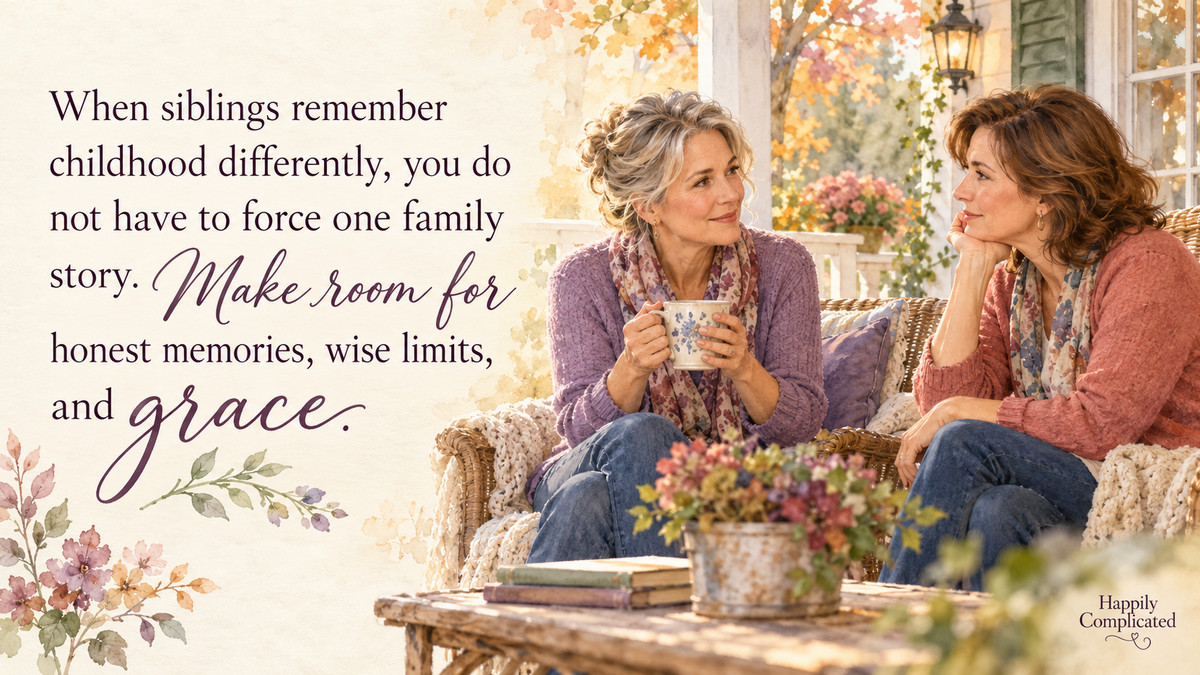
Adult siblings can grow up under the same roof and carry very different stories from it. One may remember a busy but loving home. Another may remember feeling unseen. One may laugh about a parent's temper. Another may still feel the fear it created.
These differences can become sharp when families gather, sort through old events, or make decisions about aging parents. You may feel that your sibling is rewriting the past. They may feel that you are protecting a version of the family that never felt true to them.
You do not have to settle every memory in order to treat one another with honesty and care.
The same home can feel different to each child
Children do not experience a family from the same place. Birth order, age, personality, health, family expectations, and the season their parents were living through can shape what each child noticed and carried.
A parent may have been patient during one child's early years and overwhelmed during another's. One sibling may have been protected from conflict while another stood close enough to see it. A child praised as responsible may have felt loved, while another remembers the same praise as pressure.
Different memories do not automatically mean someone is lying. They may be describing the part of the family that was most real to them.
Listen without surrendering your own experience
Making room for another person's memory does not require erasing yours. You can say, 'I remember it differently, but I believe that was painful for you.' That sentence protects both honesty and relationship.
Try to listen for the feeling beneath the details. Is your sibling asking to be believed, understood, or protected from something that still happens? You may not agree about every date or conversation, yet you can still respond to the hurt being named.
If you feel defensive, pause before answering. A quick correction may close the conversation before you understand what is actually being asked of you.
Do not make one sibling the family judge
Families sometimes push one person to declare which story is true. That role is too large for any sibling. You are not responsible for proving every memory, explaining every adult, or delivering a final verdict on the whole family.
Stay close to what you know. Speak about what you saw, what you felt, and what you can honestly own. Avoid carrying messages between adults who need to speak for themselves.
When a serious concern involves safety, abuse, legal rights, or health, wise professional support may be needed. Grace does not require treating every issue as a harmless difference of opinion.
Let boundaries protect the present
A disagreement about the past can keep repeating in the present. If every family meal becomes an argument, choose a limit. You might say that you are willing to talk privately for a set amount of time, but not to debate the same memory in front of children or other relatives.
You can also decline conversations that become insulting, manipulative, or cruel. A boundary is not proof that you do not care. It may be the only way to keep the relationship from becoming another place where harm is repeated.
If repair is possible, focus on present choices. Ask what respect looks like now. Small changes in how you speak, visit, share information, or handle family responsibilities can matter even when the past remains unsettled.
Bring the unfinished story to God
God sees every part of a family story, including what no one else noticed. You can ask Him for humility about what you may have missed and courage about what you need to name.
You may never reach one shared version of childhood. Peace does not always arrive through agreement. Sometimes it grows through honest words, wise distance, a sincere apology, or the choice to stop forcing another person to confirm your memory.
Make room for honest memories, wise limits, and grace. Your family story can be complicated without making truth or love impossible.