Home, Grief & Memory
When Letting Go of Belongings Feels Like Losing the Memory
A treasured object can carry love, grief, and history. Releasing it does not erase the person or season it represents.
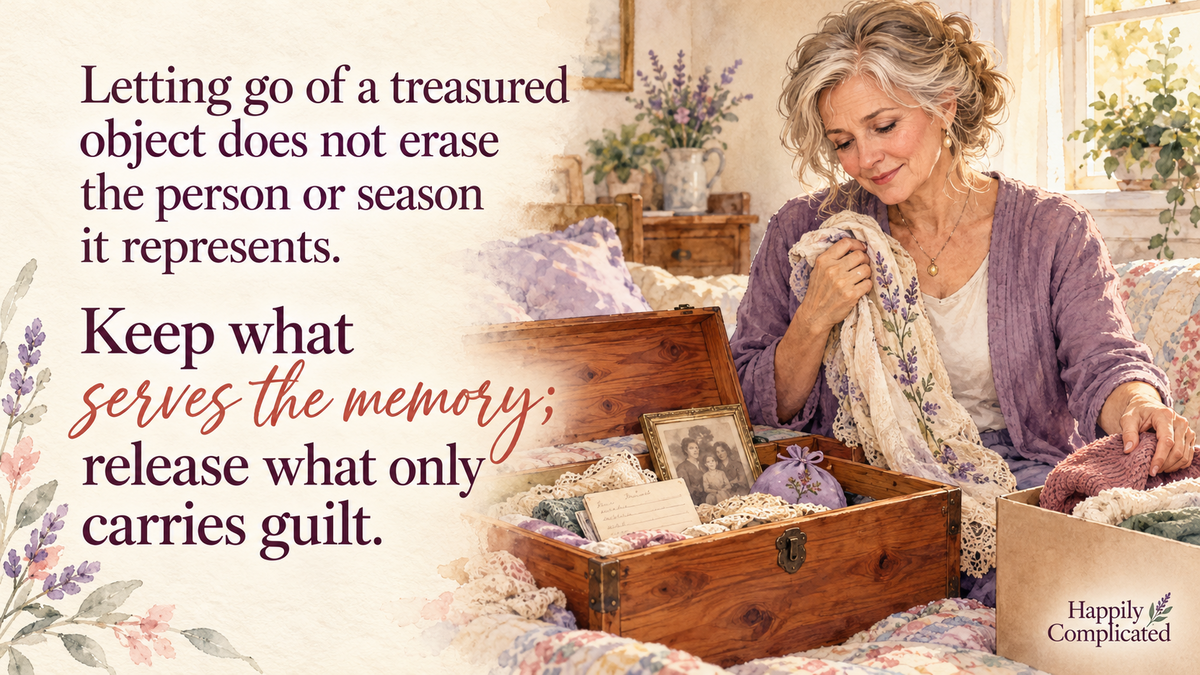
Some belongings are more than things. A scarf still carries a familiar scent. A chipped bowl remembers Sunday dinners. A box of cards holds the handwriting of someone whose voice you can no longer hear.
That is why sorting a closet, attic, or family home can feel surprisingly heavy. You may know there is too much to keep, yet every object seems to ask whether love mattered. Letting go can feel like a second loss.
You do not have to rush this work. You also do not have to keep everything in order to prove that the person, place, or season was important.
Objects can become proof of love
After a loss or major change, a possession may begin carrying a job it was never meant to hold. It becomes proof that the relationship was real, that the family had a history, or that an earlier version of your life existed.
The object can be meaningful without being responsible for preserving the whole story. A dress cannot hold every conversation with your mother. A tool cannot contain everything your father taught you. A child's old bedroom cannot keep childhood from moving forward.
Naming that truth may bring tears. It can also loosen the fear that releasing one thing will erase what happened.
Keep what helps you remember well
You do not need to choose between keeping everything and keeping nothing. Look for the few pieces that help the memory feel clear, warm, or honest.
You might keep one recipe card instead of the entire kitchen drawer, one quilt instead of every linen, or several photographs instead of a box you never open. A representative item can carry meaning without asking your home to become a storage place for every chapter.
Choose what you can use, display, share, or revisit with care. The goal is not a perfect number. The goal is to let your space support the life you are living now.
Notice when guilt is making the decision
Guilt often sounds like a rule. A good daughter would keep this. A loving mother would save that. The family will think I did not care. Those thoughts can make every choice feel like a moral test.
Pause and ask a gentler question: Does keeping this help me honor the memory, or does it only make me afraid to let go?
If an item brings only pressure, confusion, or a duty you cannot fulfill, releasing it may be wise. Donating something useful can allow another person to receive it. Passing an heirloom to a family member who wants it can keep the story moving. Taking a photograph may be enough for an object you cannot store.
Let family members own their choices
Family belongings can uncover old roles and disagreements. One person wants everything saved. Another wants the room cleared quickly. Someone may expect you to manage the entire process because you have always been the responsible one.
Set a clear and fair plan. Tell relatives what is available, give a reasonable time to respond, and ask them to take responsibility for the items they choose. You do not have to store another adult's memories forever because they do not have room.
If the belongings are tied to an estate or shared ownership, slow down and handle the legal and family responsibilities carefully. Practical clarity can prevent regret and unnecessary conflict.
Make room for grief without building a shrine to guilt
Sorting meaningful belongings may need several short sessions instead of one exhausting day. Stop when your thoughts become foggy or every choice begins to hurt. Invite a steady person to sit with you if doing it alone feels too heavy.
Bring the memory to God in plain words. Thank Him for what was good. Name what still hurts. Ask for wisdom about what to carry forward and what can be released.
God does not measure love by the number of boxes in your home. The relationship, lesson, and season have already shaped you. They are part of your story even when the object is no longer in your hands.
Keep what serves the memory. Share what may bless someone else. Release what only carries guilt. Letting go of a treasured belonging does not let go of the love it represents.