Aging, Identity & Grace
Using a Mobility Aid Without Shame
A cane, walker, or other support can protect your safety without becoming a verdict about your worth, strength, or place in the world.
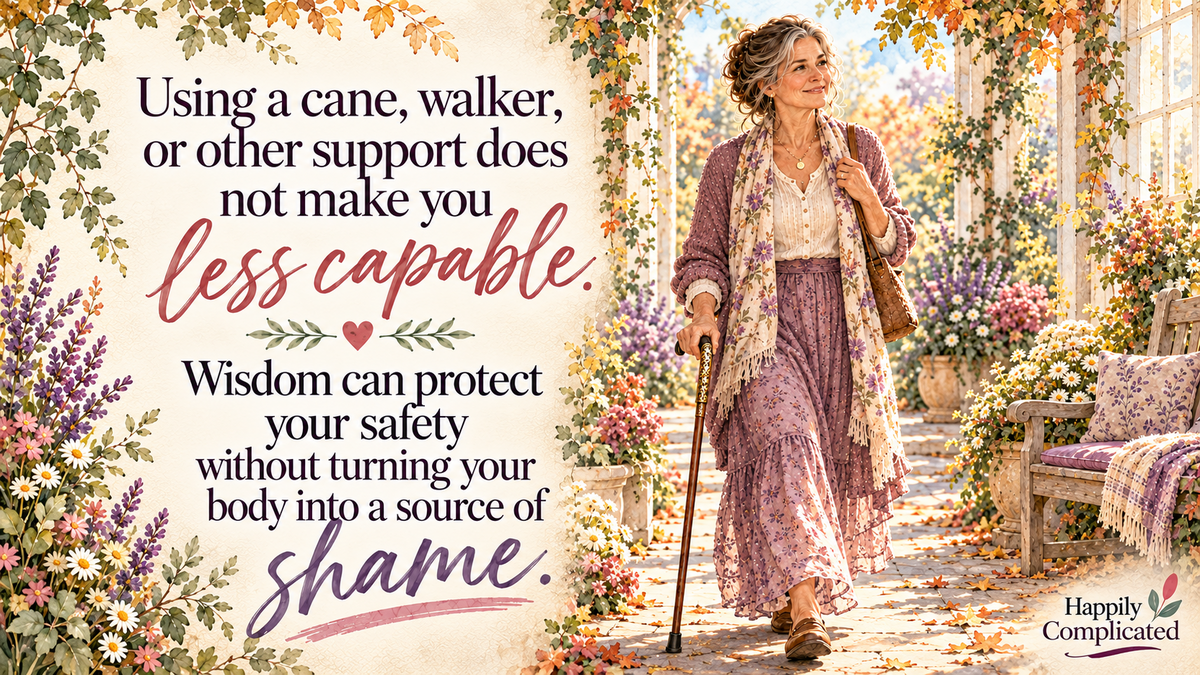
The first time you reach for a cane, walker, brace, or another kind of support, the moment may feel larger than the object itself. You may think about who will notice, what they will assume, or whether using it means a part of your life has ended.
Those feelings can be real even when the support helps. Relief and grief can sit beside each other. You can be thankful for steadier movement and still wish your body did not need anything extra.
A mobility aid is not a report on your character. It is a tool. Using one can be a wise response to the body you have today, without making that body a source of shame.
Notice the story attached to the object
Many of us grew up seeing a cane or walker as a sign that someone had become weak, old, or dependent. Those narrow pictures can stay with us long after we know better. When the need becomes personal, an ordinary tool may feel like a label we never chose.
Ask yourself what the aid seems to say in your mind. Does it tell you that people will stop seeing your competence? That you will become a burden? That you should hide a change you cannot control? Naming the fear helps you separate it from the truth.
You are still the woman who has learned, loved, worked, solved problems, cared for people, and made difficult decisions. A support in your hand does not remove the life inside you.
Let wisdom include safety
There is no prize for making an ordinary task more dangerous in order to look independent. Wisdom pays attention. It allows new information to change the plan.
If you are uncertain about what kind of support fits your needs or how to use it safely, seek guidance from a qualified health professional. Good instruction can help you understand the equipment instead of relying on guesswork or embarrassment.
Safety is not the enemy of courage. Sometimes courage looks like walking into a room with the help you need instead of staying home because you are afraid of being seen with it.
Keep your taste and your choices
Support does not have to erase personal style. You may choose a color, handle, bag, or accessory that feels like you. You can wear the clothes you enjoy and move at a pace that respects your body.
You are also allowed to decide how much explanation to give. A simple answer such as, 'This helps me move more safely,' may be enough. You do not owe casual observers your medical history or a cheerful performance about a change that is still tender.
Let the aid serve you. It does not need to become the first fact everyone learns about you.
Receive help without surrendering your voice
People may rush to take your arm, move your equipment, or make choices for you. Some mean well but do not know what actually helps. Clear words protect dignity for everyone.
You might say, 'Please ask before helping,' or, 'I need the chair left here.' You can accept a hand when it is useful and decline one when it is not. Needing support in one area does not mean other people should take over every decision.
If someone speaks only to the person beside you, bring the conversation back with a calm question or answer. Your body may need assistance, but your voice still belongs in the room.
Make room for the feelings that come with change
You do not have to turn the adjustment into a lesson before you have had time to live it. Some days you may feel free because movement is easier. Other days you may feel angry, tired, or self-conscious.
Bring those feelings to someone safe. A trusted friend, counselor, support group, or pastor may help you grieve what changed without treating your life as though it has become smaller than it is.
Your dignity has not moved
Christian hope does not require pretending the body never changes. Scripture treats the human person as worthy of care, not as valuable only when strong, fast, or independent. Your dignity comes from being made and loved by God. It does not rest on how you cross a room.
Use the support that helps. Take the time you need. Ask for respect. Let wisdom protect your safety without turning your body into a source of shame. You are not less capable because you move with assistance. You are responding honestly to this season while continuing to live inside it.