Growth & Starting Again
The Courage to Become a Beginner Again
Starting small can feel humbling when you are used to being capable. Your first imperfect step still matters.
There is a particular kind of discomfort in being new at something when you are used to being capable. You may know how to run a home, lead a team, care for a family, solve problems, or carry responsibility without much instruction.
Then you step into a class, job, season, or skill where you do not know what you are doing. Your hands feel awkward. The questions seem obvious to everyone else. Your first attempt looks nothing like the picture in your mind.
It can be tempting to quit before anyone sees you struggle. But beginning again is not proof that your earlier strength disappeared. It is proof that your life is still able to grow.
Capability can make learning feel risky
When other people depend on you, competence can become part of your identity. You are the woman who knows, handles, remembers, and finishes. Being a beginner may feel like stepping out without the protection of that familiar role.
You may worry that asking a basic question will make people doubt everything else you can do. You may compare your first week with another person’s fifth year. You may decide you lack talent when what you actually lack is practice.
Learning asks you to be seen before you feel polished. That vulnerability is real, but it is not shameful.
Let the first attempt be small
A first step does not need to prove that you will succeed. It only needs to help you begin.
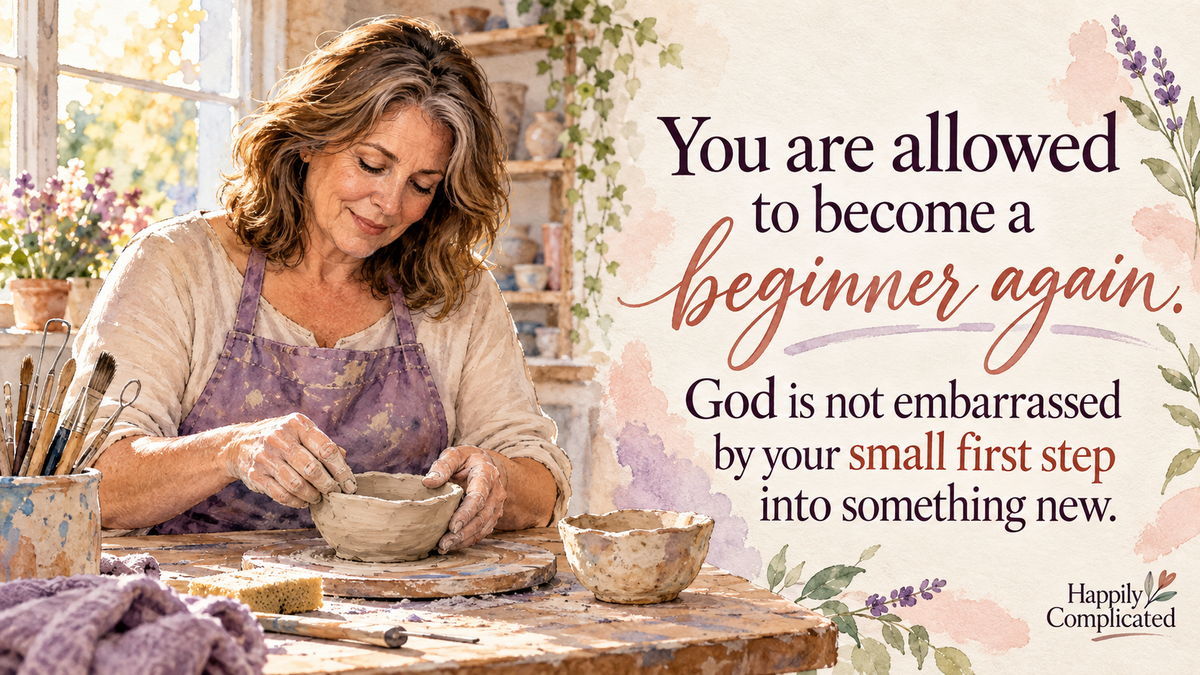
Take the short class. Write the rough page. Learn one feature of the new program. Walk for ten minutes. Make the phone call. Shape the imperfect bowl. Small action gives you information that endless worry cannot.
You may discover that you enjoy the process. You may discover that this path is not for you. Either truth is useful. Beginning does not create a lifetime contract. It gives you a real experience to learn from.
Practice without insulting yourself
Many adults speak to themselves harshly while learning. They make one mistake and say, “I am terrible at this.” They forget that every skilled person once needed instructions, repetition, and someone patient enough to answer questions.
Try using the language you would offer a child or friend. This is new. I need another attempt. I understand more than I did yesterday. That response is not pretending the work is excellent. It is giving growth enough safety to continue.
Correction is part of practice. Shame does not have to be. You can notice what went wrong, adjust, and try again without turning an imperfect result into evidence against your worth.
Learn at the pace of your real life
You may be beginning while also working, caregiving, grieving, managing health concerns, or tending a household. Your available time and energy may not match someone else’s.
Choose a pace you can return to. Twenty steady minutes may serve you better than one exhausting weekend followed by a month of avoidance. Put the next practice on the calendar. Gather what you need in advance. Ask for instruction before frustration becomes a reason to stop.
Slow progress is still progress. A limited season does not make your desire foolish. It simply asks you to build with the materials you have today.
Starting again can open a new season
Sometimes becoming a beginner is not optional. A role ends, a workplace changes, children grow, a relationship shifts, or circumstances require skills you never expected to need.
Grieve what was familiar. Then allow yourself to learn the life in front of you. You do not have to love every change before taking one useful step within it.
God is not embarrassed by your questions, your slow hands, or the humble size of your beginning. Zechariah 4:10 warns against despising small beginnings. What looks unimpressive today may simply be the honest place where faithfulness starts.
Your beginner season still has dignity
You have not become less wise because you entered a room where someone else knows more. Your past experience still belongs to you. It may even help you become a more patient learner and a kinder teacher later.
Let yourself be new. Ask the question. Make the uneven first attempt. Celebrate what you understand now that you did not understand before.
You are allowed to become a beginner again. Your small first step is not embarrassing to God. It is a brave, honest way of moving toward what comes next.